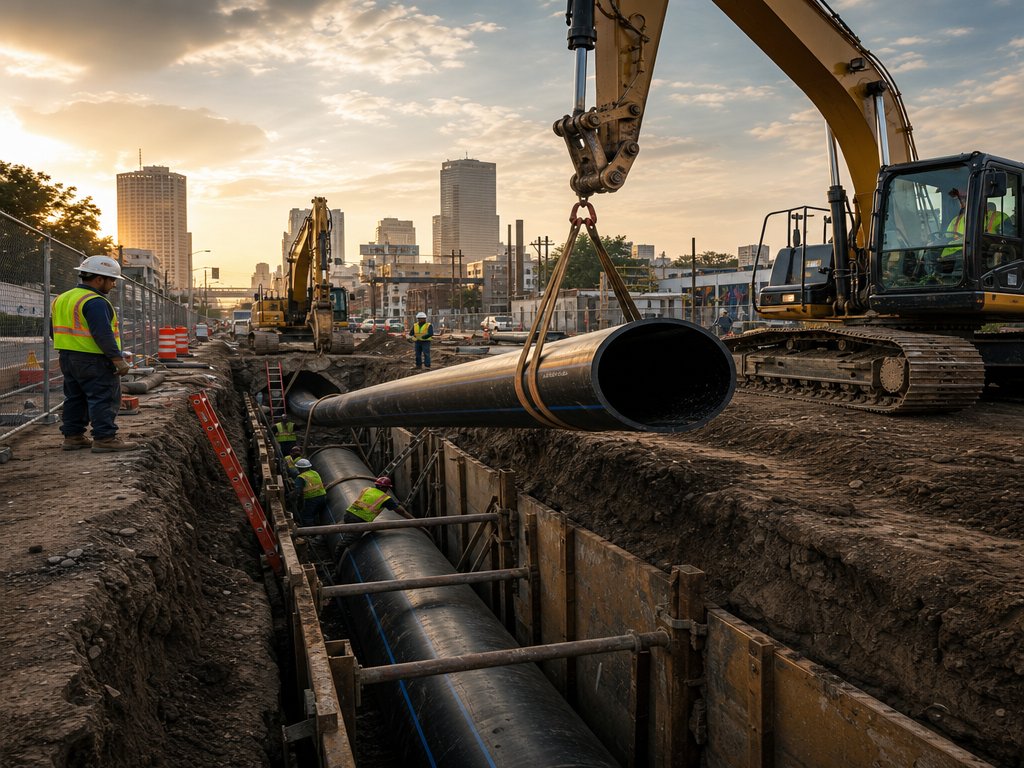
For civil engineers specifying buried water, wastewater, irrigation, or utility networks, the choice between PE80 and PE100 HDPE pipe is not a simple upgrade decision. Both are proven high-density polyethylene materials, but their molecular architecture, hydrostatic strength, environmental stress crack resistance, and design implications differ significantly. In deep underground infrastructure, where pipe performance depends on internal pressure, soil loading, installation quality, and long-term creep behavior, selecting the correct grade directly affects safety margin, service life, and total installed cost.
Understanding PE80 and PE100 Resin Classification
PE80 and PE100 are performance classifications based primarily on Minimum Required Strength, or MRS, under long-term hydrostatic testing. The classification indicates the extrapolated hoop stress the material can withstand at 20°C for 50 years under standardized testing conditions.
- PE80: MRS of 8.0 MPa, commonly used in medium-pressure water distribution, agricultural irrigation, and general buried services.
- PE100: MRS of 10.0 MPa, offering higher hydrostatic strength and commonly specified for municipal transmission mains, high-pressure networks, trenchless applications, and critical infrastructure.
For water applications using a typical design coefficient of 1.25, PE80 is generally associated with a design stress of approximately 6.3 MPa, while PE100 is associated with approximately 8.0 MPa. This difference allows PE100 pipe to achieve the same pressure rating with a thinner wall, or to deliver a higher pressure rating at the same SDR.
Molecular Density and Material Structure
Although both materials are categorized as HDPE, PE100 should not be understood merely as a denser version of PE80. Modern PE100 compounds are often produced using bimodal or advanced molecular weight distribution technology. This provides a balance between stiffness, toughness, processability, and crack resistance.
- PE80: Typically has adequate crystallinity and toughness for standard pressure networks, but may have lower long-term strength depending on compound quality and manufacturer controls.
- PE100: Usually provides improved tie-molecule formation between crystalline zones, better controlled molecular weight distribution, and enhanced long-term resistance to slow crack growth.
In practical terms, PE100 can carry higher stress without necessarily becoming brittle. This is important for deep underground installations where the pipe must deform safely under soil load while maintaining pressure integrity.
Environmental Stress Crack Resistance and Slow Crack Growth
Environmental Stress Crack Resistance, or ESCR, is a critical selection factor for buried HDPE systems. Pipes are exposed to external scratches during handling, point loads from stones, bending stress, residual stress from welding, disinfectants, and cyclic pressure. Over decades, these conditions may initiate slow crack growth if the material has poor resistance.
PE100 compounds, especially high-quality black PE100 with certified carbon black dispersion, generally offer superior resistance to slow crack growth compared with conventional PE80. This makes PE100 preferable for:
- Deep burial where inspection and repair are difficult.
- Directional drilling, pipe bursting, or sliplining where surface scoring can occur.
- High-pressure municipal mains with pressure cycling and surge events.
- Rocky trench conditions or installations with variable bedding quality.
However, ESCR is not determined by the grade label alone. Engineers should verify compliance with relevant standards, compound certification, test data, and manufacturer quality assurance.
Hydrostatic Strength and SDR Selection
The biggest engineering distinction between PE80 and PE100 is long-term hydrostatic strength. For the same nominal pressure class, PE100 often permits a higher SDR, meaning a thinner wall and larger internal diameter. This can reduce material weight, improve hydraulic capacity, and lower pumping energy.
- Same pressure rating: PE100 can often use a thinner wall than PE80, improving flow area and reducing pipe weight.
- Same SDR: PE100 provides a higher pressure rating and better safety margin.
- Deep burial: Thinner walls may reduce ring stiffness, so soil loading, embedment quality, live loads, groundwater, and deflection limits must still be checked.
For deep underground infrastructure, specifying PE100 does not automatically mean choosing the thinnest possible SDR. In high cover depths, poor soil, or heavy traffic corridors, a lower SDR with greater wall thickness may be justified to improve ring stiffness and installation tolerance.
Municipal Infrastructure: When PE100 Is Usually Preferred
Municipal networks typically require long design life, consistent pressure performance, traceable materials, and low maintenance risk. PE100 is commonly favored for city water transmission, sewer force mains, industrial water supply, and utility corridors because it offers higher pressure capacity and stronger long-term performance.
- Better suited to high-pressure distribution and transmission mains.
- Improved safety margin against surge, pressure cycling, and ground movement.
- Higher hydraulic efficiency at equivalent pressure class due to larger bore potential.
- More appropriate for trenchless construction and difficult access areas.
- Lower lifecycle risk where repair costs are high.
For municipal procurement, engineers should specify the grade, SDR or pressure class, standard compliance, jointing method, testing requirements, and resin traceability. The pipe system should be evaluated as a complete solution, not only by material price per meter.
Agricultural and Rural Networks: Where PE80 May Still Be Practical
PE80 remains useful in many agricultural grids, rural water distribution lines, low-to-medium pressure irrigation systems, and temporary or semi-permanent services. Where operating pressure is moderate, burial depth is controlled, and maintenance access is easier, PE80 can provide a cost-effective solution.
- Suitable for many irrigation laterals and medium-pressure farm distribution lines.
- Often economical where pressure requirements are modest.
- Can be appropriate when trench conditions are predictable and bedding is well managed.
- May be selected where project budgets prioritize initial material cost over maximum pressure capacity.
That said, agricultural systems are increasingly exposed to higher pumping pressures, longer runs, chemical fertilizers, uneven trenching, and seasonal thermal movement. In these cases, PE100 may deliver better long-term value even if the initial pipe price is higher.
Engineering Selection Criteria
A rigorous PE80 versus PE100 specification should consider more than the nominal pressure rating. The following criteria are recommended for deep underground projects:
- Operating and surge pressure: Calculate steady-state pressure, transient events, pump start-stop cycles, and maximum allowable operating pressure.
- Burial depth and external loads: Check soil cover, traffic loading, groundwater, trench width, native soil strength, and compaction quality.
- SDR and ring stiffness: Ensure that wall thickness supports both pressure performance and acceptable long-term deflection.
- ESCR and crack growth resistance: Request compound test data, particularly for trenchless work or rocky soils.
- Jointing quality: Butt fusion and electrofusion procedures must match the pipe grade and be performed by trained operators.
- Chemical and temperature exposure: Consider disinfectants, industrial effluent, fertilizers, elevated water temperature, and UV exposure before installation.
- Lifecycle cost: Compare not only pipe price but also installation speed, pumping efficiency, repair risk, and design life.
Conclusion: PE100 for Critical Depth and Pressure, PE80 for Controlled Moderate-Duty Networks
PE80 and PE100 are both viable HDPE pipe materials, but they are optimized for different risk profiles. PE80 remains a dependable option for controlled, medium-pressure agricultural and rural systems. PE100 is generally the stronger choice for deep underground municipal infrastructure, higher-pressure mains, trenchless installation, and projects where repair access is limited.
For wholesale buyers, contractors, and engineering teams, the best specification is not simply PE100 by default or PE80 for cost saving. The correct decision should integrate pressure class, SDR, burial depth, ESCR, installation method, and long-term operational risk. Sputnik Trading supports B2B buyers in Thailand with material selection guidance for HDPE pipe systems suited to municipal, agricultural, and infrastructure applications.