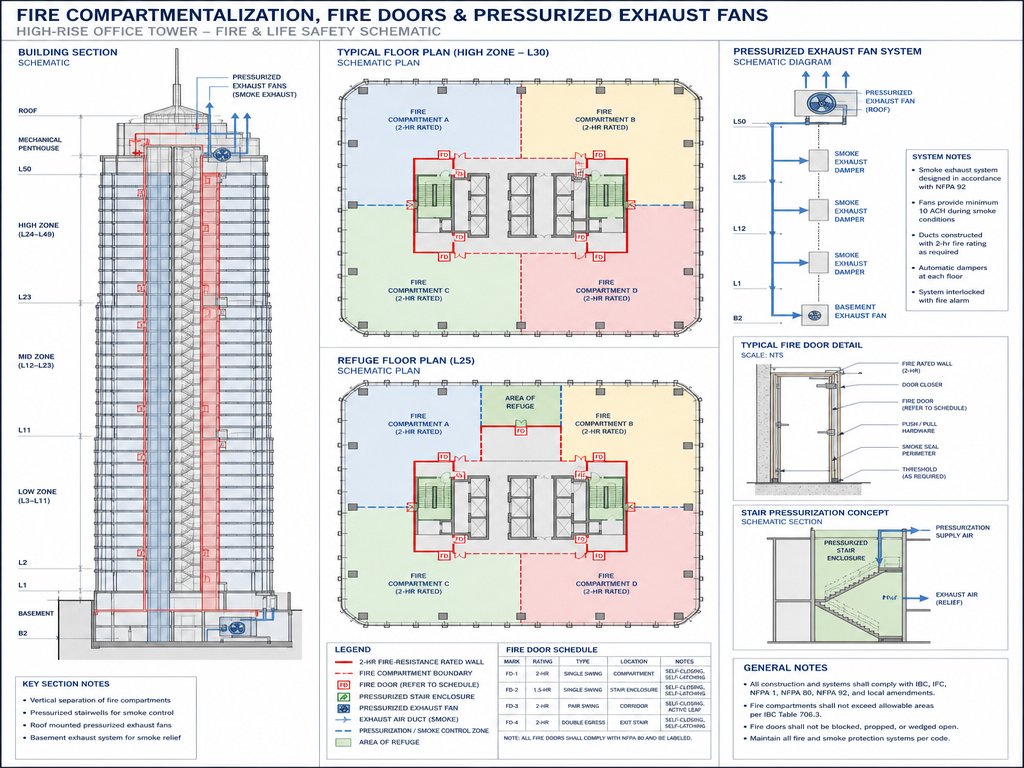
For architects, developers, project managers and MEP contractors working on high-rise buildings in Thailand, Ministerial Regulation No. 33 is no longer a technical clause to review late in the approval process. The updated fire-safety expectations affect core planning, structural detailing, procurement, site inspection and handover documentation. Non-compliance can lead to redesign, delayed permits, rejected inspections, higher insurance scrutiny and serious life-safety risk.
This guide summarizes the critical compliance points now shaping high-rise design: escape stair geometry, 2-hour fire-rated structural barriers, E160 firestopping and pressurized refuge floors for buildings over 100 meters.
1. Fire escape geometry: small dimensions, major approval impact
Fire stairs must be designed as life-safety infrastructure, not as leftover space in the core. The regulation’s dimensional requirements are especially important because they affect architectural planning from the earliest schematic stage.
- Minimum clear stair width: 90 cm must be maintained as usable egress width, not reduced by finishes, handrails, door swings, services or site modifications.
- Minimum tread depth: 22 cm is a critical threshold for safe descent, particularly during panic conditions, smoke exposure or evacuation by elderly occupants.
- Consistent stair geometry: riser height, tread depth, landing dimensions and handrail continuity must be coordinated to avoid trip hazards.
- Protected egress route: stair doors, shafts and corridors must work as a continuous fire-safe path from occupied floors to final discharge.
The key lesson for design teams is simple: do not wait until shop drawings to check stair compliance. A 90 cm clear width requirement can be lost quickly when wall build-ups, door frames, handrails and fire-rated linings are added.
2. Shift toward 2-hour fire-rated structural barriers
High-rise fire strategy is moving from basic compartmentation to more robust fire separation. Fire-rated barriers must delay fire spread long enough for evacuation, fire-fighting access and emergency response. For critical elements, the benchmark is now a 2-hour fire-resistance performance.
- Fire-rated stair enclosures and lift lobbies
- Service shafts and risers carrying electrical, plumbing, HVAC and communication systems
- Fire compartment walls and protected corridors
- Plant rooms, transformer rooms, generator rooms and other high-risk service areas
- Refuge floor separation and protected evacuation areas
Specifiers should avoid treating a fire-rated wall as only a board or blockwork item. The rating depends on the full tested assembly: substrate, board layers, framing, density, joints, fixings, sealants, doors, dampers and penetration seals. Substituting one component can invalidate the claimed performance.
3. E160 firestops: penetrations are now a compliance hotspot
Even a 2-hour fire-rated wall or floor fails if pipes, cables, ducts and sleeves are left unsealed. E160 firestops are designed to maintain fire integrity for 160 minutes at service penetrations and construction joints. This is one of the most urgent issues for Thai high-rise projects because penetrations are often added or enlarged during MEP installation.
- Use tested firestop systems for cable trays, conduits, metal pipes, plastic pipes, insulated pipes and mixed-service openings.
- Match the firestop system to the actual wall or floor type, opening size, service material and required rating.
- Require installation drawings, product certificates, test reports and method statements before site installation.
- Photograph each penetration before and after sealing for inspection records and building handover.
- Control post-installation coring. Any new hole through a rated barrier must be re-sealed with an approved firestop system.
Developers should make firestopping a separate quality-control package, not a minor patching task at the end of the project. The cost of late correction is far higher than early coordination.
4. Pressurized refuge floors for buildings over 100 meters
For high-rise buildings over 100 meters, refuge floors become a critical life-safety feature. They provide protected temporary shelter, support phased evacuation and assist fire-fighting operations. However, a refuge floor is not just an empty floor plate. It must be integrated with fire separation, ventilation, smoke control and emergency power.
- Positive pressure must be maintained to prevent smoke migration into refuge areas and protected stairs.
- Air leakage through doors, shafts and façade joints must be considered in the pressurization calculation.
- Emergency lighting, signage, communication systems and fire-fighting access must be coordinated.
- Fire-rated separation must protect the refuge area from adjacent hazards.
- Mechanical systems should be linked to emergency power, fire alarm logic and building management controls.
Because Thailand’s tall buildings often combine residential, hotel, office and retail functions, the refuge strategy must consider different occupant loads, mobility levels and evacuation behavior.
5. What architects and developers should do now
- Audit current designs: check stair width, tread dimensions, compartmentation lines, shaft layouts and refuge floor planning before permit submission.
- Lock fire-rated assemblies early: specify complete tested systems, not generic material descriptions.
- Coordinate MEP penetrations: create a penetration register and assign responsibility for E160 firestop installation and inspection.
- Demand documentation: keep test reports, certificates, installation records and as-built drawings ready for authority review and future building inspection.
- Procure from reliable suppliers: choose materials with verifiable performance data, stable availability and technical support for site teams.
Ministerial Regulation No. 33 raises the standard for high-rise fire safety in Thailand. For project owners, compliance is not only about passing inspection; it is about protecting occupants, preserving asset value and reducing liability over the full life of the building.
Sputnik Trading supports developers, contractors and specifiers with professional-grade construction materials for fire-rated assemblies, service penetrations and high-rise building systems. For urgent projects, early material selection and documentation support can make the difference between smooth approval and costly redesign.