In high-rise hotels, serviced apartments, hospitals, and mixed-use towers, hot and cold water pipework is exposed to repeated temperature changes. Standard PP-R pipes are widely used because they are corrosion-resistant, hygienic, and easy to weld. However, when long horizontal runs or vertical risers carry hot water, linear thermal expansion becomes a serious engineering consideration.
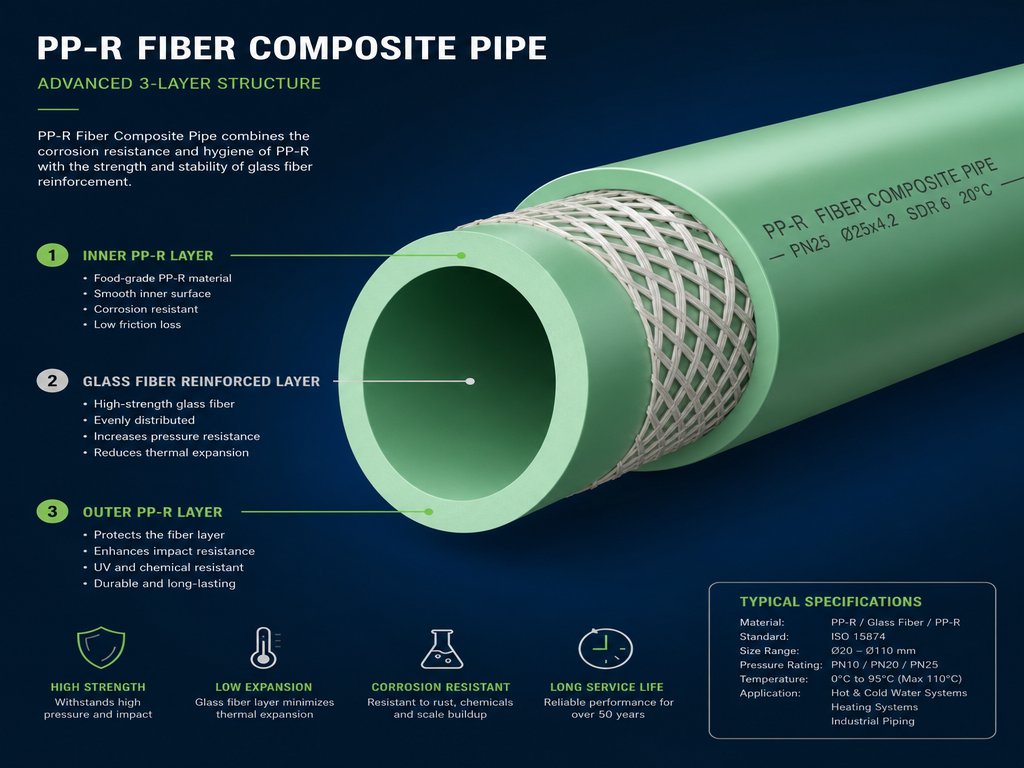
Premium green fiber composite PP-R pipes are designed to solve this issue. By integrating a middle glass-fiber reinforced layer between PP-R layers, these pipes significantly reduce linear expansion, often achieving up to three times better dimensional stability compared with standard PP-R. For contractors and MEP designers, this can mean fewer expansion loops, cleaner shaft layouts, reduced stress at fittings, and more reliable long-term operation.
Why standard PP-R expands in hot water systems
All plastic pipes expand when temperature rises. PP-R has a relatively high coefficient of linear thermal expansion compared with metal piping. In short pipe branches, this movement may be manageable. In high-rise plumbing grids, especially in hotel domestic hot water and recirculation lines, expansion can accumulate over long distances.
The basic calculation is:
ΔL = α × L × ΔT
- ΔL = change in pipe length, in mm
- α = coefficient of linear thermal expansion, in mm/m·°C
- L = pipe length, in metres
- ΔT = temperature difference, in °C
Typical design values are approximately:
- Standard PP-R: α ≈ 0.15 mm/m·°C
- Fiber composite PP-R: α ≈ 0.035 to 0.05 mm/m·°C, depending on manufacturer and pipe class
This means a fiber composite PP-R pipe can reduce thermal movement by around 65 to 75%, or provide up to approximately 300% improvement in expansion control compared with standard PP-R.
How the glass-fiber middle layer works
Fiber composite PP-R is normally manufactured as a multilayer pipe. The inner layer remains PP-R for clean water contact and heat resistance. The outer layer remains PP-R for weldability and durability. The middle layer contains glass fiber reinforcement that restrains the pipe wall from elongating excessively when temperature changes.
The result is a pipe that behaves more rigidly under thermal load while retaining the advantages of PP-R socket fusion welding. Because the expansion is lower, the pipe places less stress on elbows, tees, valves, supports, and riser anchors.
Example 1: 30-metre hotel hot water riser
Consider a hotel domestic hot water riser installed at 25°C and operating at 60°C.
- Pipe length: 30 m
- Temperature change: 60°C - 25°C = 35°C
- Standard PP-R expansion: 0.15 × 30 × 35 = 157.5 mm
- Fiber composite PP-R expansion at 0.05: 0.05 × 30 × 35 = 52.5 mm
In this example, the standard PP-R riser may move by almost 160 mm, while the fiber composite pipe moves about 53 mm. That is a reduction of approximately 105 mm. In a tight plumbing shaft with multiple risers, valves, and branch connections, this difference is significant.
Example 2: 12-metre corridor distribution line
Hotel plumbing often includes long horizontal distribution runs above corridor ceilings. These lines may serve guestroom clusters and can experience fluctuating temperatures when occupancy changes.
- Pipe length: 12 m
- Installation temperature: 28°C
- Operating hot water temperature: 65°C
- Temperature change: 37°C
- Standard PP-R expansion: 0.15 × 12 × 37 = 66.6 mm
- Fiber composite PP-R expansion at 0.05: 0.05 × 12 × 37 = 22.2 mm
A 66 mm movement can push against ceiling supports, create bowing, or transfer stress to fittings. A 22 mm movement is much easier to control with proper clamps and planned offset sections.
Design implications for high-rise MEP teams
Lower expansion does not mean zero expansion. Fiber composite PP-R still requires professional design, correct support spacing, and allowance for movement. However, it gives engineers a wider safety margin and helps reduce installation complexity.
- Riser shafts: Reduced axial movement helps protect branch take-offs on each floor.
- Hot water recirculation: Continuous temperature cycling creates expansion fatigue; lower movement improves stability.
- Ceiling voids: Less sagging and bowing helps maintain clean coordination with electrical, HVAC, and fire protection systems.
- Plant rooms: Lower stress near pumps, heaters, and valves reduces the risk of noise, vibration, and joint strain.
- Expansion loops: Designers may reduce the size or number of compensating sections, subject to manufacturer guidelines.
Practical checklist before specification
- Confirm the pipe’s coefficient of expansion from the manufacturer’s datasheet.
- Check pressure rating, temperature rating, and long-term performance class for domestic hot water.
- Use compatible fittings and welding tools from approved systems.
- Follow recommended support spacing for vertical and horizontal runs.
- Plan fixed points, sliding supports, offsets, and expansion compensation before installation.
- Review shaft and ceiling coordination drawings to avoid clashes caused by pipe movement.
Conclusion
For high-rise hotel plumbing grids, thermal expansion is not a minor detail. It affects shaft space, ceiling coordination, fitting stress, noise control, and long-term maintenance. Standard PP-R remains a practical material, but fiber composite PP-R offers a clear engineering advantage in hot water and recirculation systems.
By using the simple formula ΔL = α × L × ΔT, MEP designers and contractors can quantify the difference before installation. In long risers and corridor distribution lines, premium green PP-R pipes with a glass-fiber middle layer can reduce expansion dramatically and help deliver a cleaner, more reliable high-rise plumbing system.