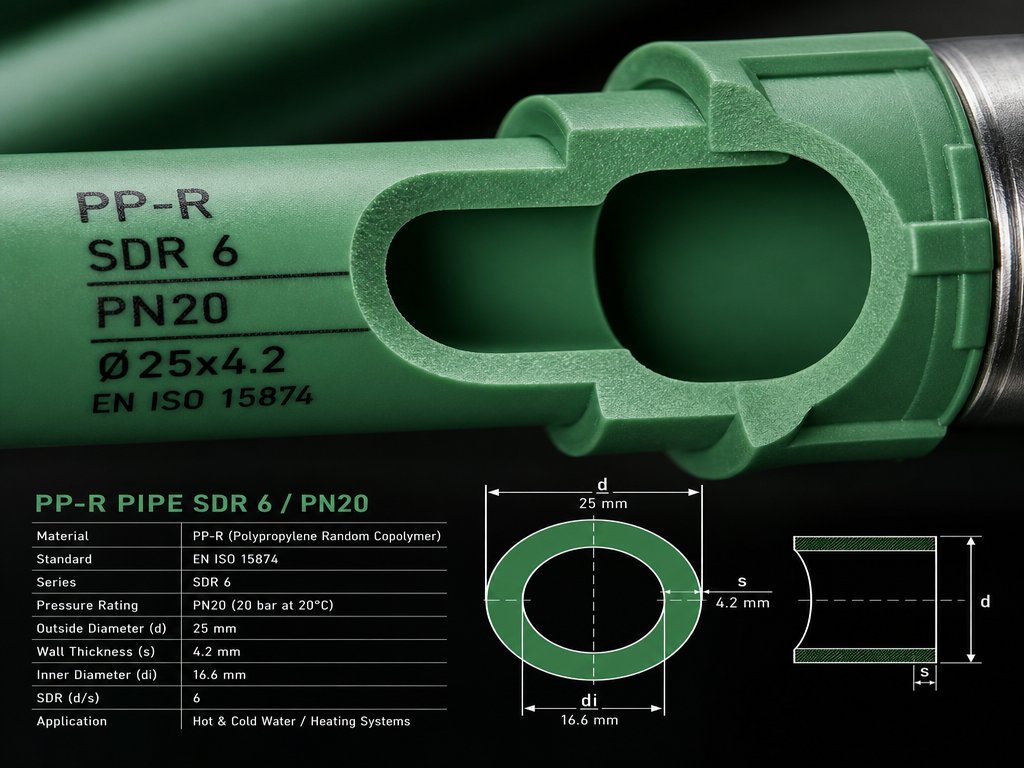
For engineers, MEP contractors, and procurement teams, PP-R green pipe selection should never be based on color or price alone. The two numbers that determine whether a pipe can safely carry cold water or high-temperature hot water are SDR and PN. In practical terms, these ratings define wall thickness, allowable stress, thermal derating, and long-term resistance to creep failure.
What Is SDR?
SDR stands for Standard Dimension Ratio. It is a geometric relationship between the pipe outside diameter and its wall thickness:
SDR = outside diameter / wall thickness
A lower SDR means a thicker wall. For example, SDR 6 has a much thicker wall than SDR 11 for the same outside diameter. This is critical because wall thickness controls the hoop stress generated by internal pressure.
Hoop Stress: The Core Engineering Principle
When water pressure acts inside a pipe, it creates circumferential tensile stress in the pipe wall. For thermoplastic pressure pipes, hoop stress can be approximated as:
σ = P(SDR - 1) / 2
Where σ is hoop stress and P is internal pressure. This equation shows why SDR is not just a catalogue number. At the same pressure:
- SDR 11 produces stress proportional to 10P/2 = 5P.
- SDR 6 produces stress proportional to 5P/2 = 2.5P.
- Therefore, SDR 11 subjects the polymer wall to roughly twice the hoop stress of SDR 6.
This difference becomes decisive when the pipe is exposed to hot water.
What Does PN Mean?
PN means Nominal Pressure. A pipe marked PN10, PN16, or PN20 is commonly understood as being suitable for a nominal pressure class under standard reference conditions, typically around 20°C. However, PN is not a constant rating at all temperatures. PP-R, like all thermoplastics, loses allowable stress capacity as temperature rises.
This is where many installation failures begin: a pipe that appears adequate for pressure at room temperature can become under-designed when the water temperature reaches 60°C, 80°C, or 95°C.
Polymer Physics: Why Temperature Changes Everything
PP-R is a random copolymer polypropylene material. It is excellent for potable water, corrosion resistance, and welded-joint reliability, but it remains a viscoelastic polymer. Under pressure, the pipe wall slowly deforms over time, a behavior known as creep. Higher temperature accelerates molecular movement, reduces long-term hydrostatic strength, and increases creep rate.
At 95°C, the polymer chains have far greater mobility than at ambient temperature. If the pipe wall is too thin, internal pressure causes progressive deformation, micro-cracking, swelling, and eventual rupture. This is why pipe selection for hot water must be based on long-term pressure-temperature performance, not only on short-term burst strength.
Why SDR 6 PN20 Is Required for 95°C Hot Water
For high-temperature hot water systems, SDR 6 PN20 is the conservative and technically correct choice because it reduces hoop stress through increased wall thickness. Compared with SDR 11, SDR 6 cuts stress by approximately half at the same internal pressure. This safety margin is essential when temperature derating dramatically lowers the allowable stress of PP-R.
In engineering terms, SDR 6 provides:
- Lower hoop stress under the same operating pressure.
- Greater resistance to long-term creep at elevated temperature.
- Improved safety margin against thermal expansion stress and pressure fluctuation.
- Better reliability for hotel, hospital, condominium, and commercial hot water risers.
- Reduced risk of catastrophic failure at joints and high-stress pipe sections.
For 95°C hot water applications, SDR 11 PN10 should not be substituted for SDR 6 PN20. Even if the operating pressure appears moderate, the combined effect of temperature, pressure, installation stress, and service life can exceed the pipe’s safe working envelope.
Why SDR 11 PN10 Is Sufficient for Ambient Cold Water
Cold water systems operate at much lower thermal stress. At ambient temperature, PP-R retains significantly higher hydrostatic strength, and creep progresses much more slowly. For typical building cold water distribution, SDR 11 PN10 is often sufficient when the working pressure, pump setting, and installation environment are within the manufacturer’s specification.
SDR 11 also offers practical benefits for cold water applications:
- Lower material cost compared with thicker-wall pipe.
- Larger internal bore for the same outside diameter, reducing friction loss.
- Easier handling and faster installation.
- Adequate performance for ambient potable water lines when correctly designed.
Fluid Dynamics: Wall Thickness Also Affects Flow
As SDR decreases, wall thickness increases and the internal diameter becomes smaller. This can increase velocity and friction loss if the same outside diameter is used. Engineers should therefore calculate flow demand, pressure loss, pump head, and fixture loading before finalizing pipe size. In many hot water projects, the correct solution is not to downgrade the SDR, but to increase the nominal pipe size while keeping the required SDR 6 PN20 pressure-temperature rating.
Best-Practice Selection Guide
- Use SDR 6 PN20 for 95°C hot water, hot water risers, recirculation loops, plant rooms, and high-temperature service.
- Use SDR 11 PN10 for ambient cold water where pressure and temperature remain within approved limits.
- Check the manufacturer’s pressure-temperature derating table before approval.
- Verify compliance with relevant standards such as ISO 15874, DIN specifications, and local project requirements.
- Never mix incompatible SDR classes in critical hot water lines unless the design is reviewed by a qualified engineer.
- Allow for thermal expansion using proper supports, guides, anchors, and expansion loops.
Conclusion
SDR and PN are engineering safety parameters, not simple product labels. SDR defines the stress level in the pipe wall, while PN indicates pressure classification under reference conditions. For ambient cold water, SDR 11 PN10 can be an efficient and economical choice. For 95°C hot water, SDR 6 PN20 is required because the thicker wall dramatically reduces hoop stress and protects against creep-related failure. Selecting the correct PP-R green pipe at the design stage is the most cost-effective way to prevent leakage, downtime, and catastrophic system failure.