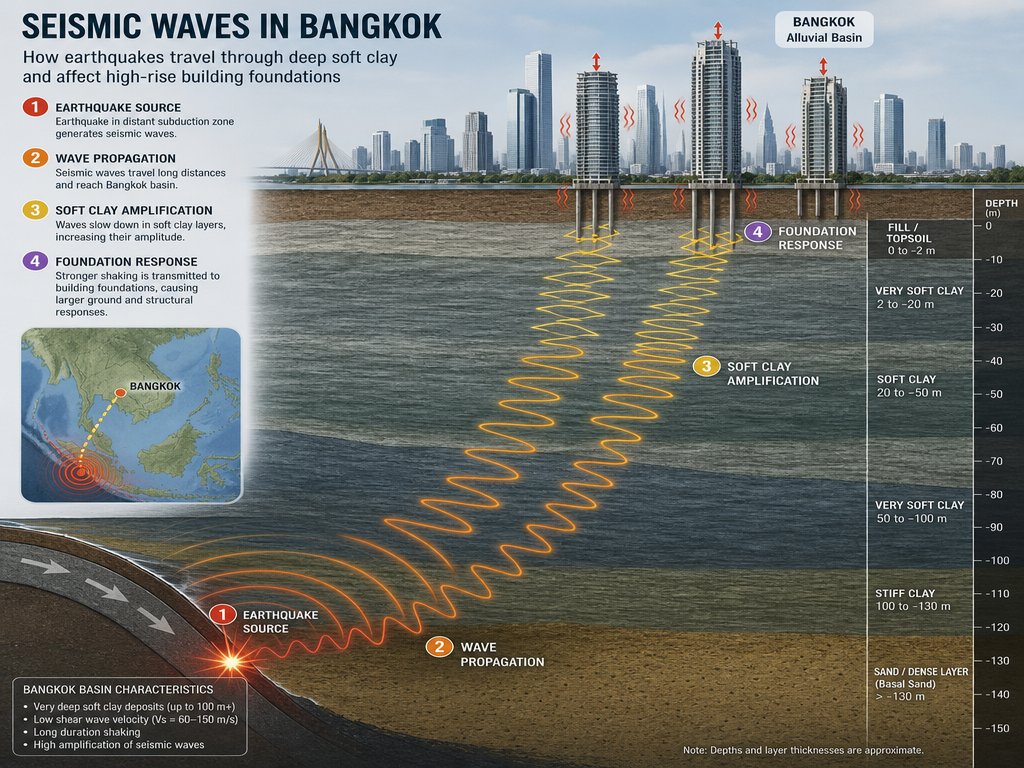
Thailand is not normally perceived as a high-seismic country, yet modern building practice no longer treats earthquake loading as an optional check. The 2021 Ministerial Regulation on earthquake resistance, together with the engineering guidance widely used by Thai designers, has pushed seismic compliance into mainstream structural design, procurement, and site inspection. For developers, contractors, and material suppliers, the key issue is not only whether a building is located near an active fault, but how the structural system responds to amplified ground motion, especially in soft-soil basins such as Bangkok.
Regulatory context: what the 2021 requirements changed
The 2021 earthquake resistance framework requires designated buildings to be designed and detailed for seismic forces according to location, building importance, structural system, height, occupancy, and soil condition. In practice, engineers commonly coordinate the Ministerial Regulation with Department of Public Works and Town & Country Planning criteria, Engineering Institute of Thailand guidance, and Thai Industrial Standards for construction materials. The objective is clear: prevent collapse, provide ductile energy dissipation, and ensure that critical buildings remain safe after a design-level earthquake.
The three-zone approach in Thai seismic design
A central compliance task is identifying the correct seismic zone and then applying the appropriate analysis and detailing level. The distinction between Zone 1, Zone 2, and Zone 3 is more than a map exercise; it directly affects base shear, drift control, reinforcement detailing, and inspection priorities.
- Zone 1: lower seismic demand. These areas generally have lower expected ground acceleration. Buildings may still require minimum lateral-force resistance and good structural integrity, particularly for public-use buildings or irregular structures. Engineers should not assume that Zone 1 means no seismic design; it means the prescribed design demand is lower.
- Zone 2: moderate demand with major soil-amplification concern. This zone is critical for Bangkok and surrounding provinces because deep soft clay can amplify long-period shaking. Tall buildings, long-span structures, transfer-girder systems, and flexible moment frames may experience increased displacement demand even when the earthquake source is far away. Site response, natural period, and drift become major design checks.
- Zone 3: higher seismic demand. Areas closer to active faults, particularly in the North and along western border regions, require more rigorous seismic design. Ductile detailing, capacity design, diaphragm continuity, foundation stability, and non-structural anchorage are central compliance items.
Why Bangkok’s soft clay changes the engineering problem
Bangkok is a prime example of why seismic zoning cannot be interpreted only by distance from an epicenter. The city is underlain by thick layers of soft marine clay, which can lengthen and amplify ground motion. For mid-rise and high-rise buildings, this creates a resonance risk where the building period aligns with amplified soil motion. Engineers therefore need to evaluate spectral response, story drift, P-delta effects, and foundation-structure interaction, not merely calculate a simplified horizontal force.
Moment-resisting concrete frames: compliance essentials
Reinforced concrete moment frames are common in Thailand because they suit local construction skills, material availability, and architectural flexibility. Under seismic loading, however, a moment frame must behave as a ductile system rather than a brittle concrete cage. Compliance typically focuses on the following requirements:
- Strong-column weak-beam behavior: plastic hinges should form in beams before columns so that the structure can dissipate energy without losing vertical load capacity.
- Confinement reinforcement: closely spaced hoops and ties are required in plastic hinge regions, beam-column joints, and column end zones to prevent brittle crushing and bar buckling.
- Beam-column joint shear: joints must be designed and detailed to transfer cyclic forces without diagonal cracking or anchorage failure.
- Development length and lap splices: reinforcement must have adequate anchorage, and lap splices should be kept away from high-stress plastic hinge zones where required.
- Drift control: story drift limits protect both structural safety and non-structural components such as masonry infill, façade systems, ceilings, and MEP services.
- Irregularity management: soft stories, torsional eccentricity, heavy transfer floors, discontinuous walls, and floating columns require careful analysis and detailing.
Material specifications that support seismic performance
Good seismic design fails if materials are inconsistent. Reinforcing steel should meet the relevant Thai Industrial Standards, with mill certificates, mechanical properties, bend performance, and traceability reviewed before installation. Concrete should be specified not only by compressive strength but also by workability, durability, cover, curing method, and quality control. For seismic zones, contractors should pay particular attention to correctly bent stirrups, seismic hooks, tie spacing, bar congestion at joints, and avoiding honeycombing in confined regions.
Practical compliance checklist for contractors and developers
- Confirm the project’s seismic zone and soil class during concept design, not after structural drawings are complete.
- Require a structural design basis report identifying code assumptions, response spectrum, importance factor, structural system, and drift limits.
- Review RC frame detailing at beam-column joints, column ends, coupling beams, transfer levels, and diaphragm connections.
- Coordinate architectural, façade, MEP, and masonry details so non-structural components are anchored and allowed to move safely.
- Use compliant reinforcement and concrete materials with proper documentation and site testing.
- Inspect rebar placement before every pour, especially hoop spacing, hooks, lap locations, cover blocks, and congestion at joints.
Procurement impact: seismic compliance is a supply-chain issue
For wholesale construction material buyers, seismic regulation changes the meaning of compliance. It is not enough to buy steel and concrete products by size or grade alone. Projects increasingly require traceable materials, verified standards, correct bar diameters, bendability, couplers where approved, grout and anchoring systems, and documentation that can pass consultant and authority review. Early coordination between structural engineers, contractors, and suppliers reduces rework, site delays, and rejection of installed materials.
Conclusion
The 2021 earthquake resistance requirements make seismic engineering a practical responsibility for Thai construction projects. Zone 1 demands basic structural integrity, Zone 3 demands rigorous ductile design, and Zone 2—especially Bangkok—demands a sophisticated understanding of soft-clay amplification. For reinforced concrete moment frames, the decisive factor is ductility: the building must be detailed to deform, redistribute forces, and avoid brittle failure. Compliance therefore depends on both engineering calculations and disciplined execution on site.