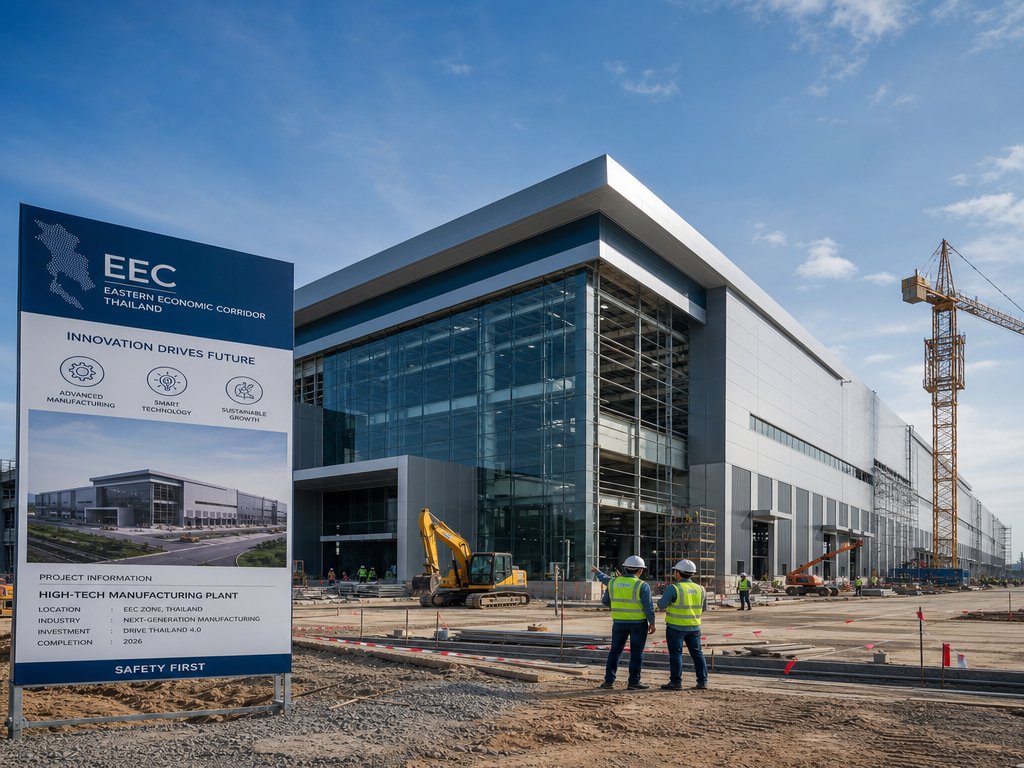
The Eastern Economic Corridor (EEC) remains Thailand’s most strategic industrial platform for manufacturers in automotive, electronics, EV, aerospace, food processing, medical devices, logistics, and advanced materials. For investors planning a factory in Chonburi, Rayong, or Chachoengsao, speed to operation depends on more than land acquisition and construction. It depends on aligning design, environmental studies, factory licensing, utilities, and material procurement from day one.
This roadmap explains how domestic and international investors can structure an industrial construction project for faster approval, with emphasis on the EEC One-Stop Service protocol, Environmental Impact Assessment (EIA) requirements, and practical strategies for obtaining the Ror Ngor 4 factory operation license where required.
1. Start with the correct location strategy
In the EEC, the permitting route is strongly influenced by whether the project is located inside an industrial estate, industrial park, or privately owned land outside a promoted zone.
- Industrial estates under IEAT: Often provide established zoning, utilities, wastewater systems, fire access, and investor support. This can reduce uncertainty during permit review.
- EEC promoted zones: May provide faster coordination and investment incentives, subject to project eligibility and compliance.
- Private land outside estates: Can offer flexibility, but usually requires closer review of town planning, access roads, drainage, wastewater discharge, environmental impacts, and community considerations.
Before committing to land, investors should verify land use zoning, flood history, road load capacity, utility capacity, wastewater connection options, and whether the intended factory activity is permitted under applicable EEC and local planning rules.
2. Understand the EEC One-Stop Service protocol
The EEC One-Stop Service (OSS) is designed to coordinate key approvals for qualified projects in the Eastern Special Development Zone. While it does not remove the need to comply with laws, it can reduce duplicated communication and help investors identify the correct approval path earlier.
A practical OSS preparation package should include:
- Company registration documents and investment structure
- Land title documents, lease agreements, or reservation documents
- Factory process description and production capacity
- Machinery list, power demand, boiler or pressure vessel details if applicable
- Preliminary architectural, structural, MEP, fire safety, and site layout drawings
- Water consumption, wastewater, air emissions, waste storage, and hazardous material data
- Construction timeline and commissioning plan
- Environmental screening to confirm whether EIA, EHIA, or other studies are required
The most efficient projects treat OSS as a coordination platform, not as a last-minute filing desk. Early consultation can reveal whether additional approvals are needed from the local administrative organization, Department of Industrial Works, Industrial Estate Authority of Thailand, Department of Public Works and Town & Country Planning, environmental authorities, or utility providers.
3. Confirm EIA prerequisites before final design
Environmental approval is often the critical path item for heavy industry, chemical processing, large-scale manufacturing, power-related facilities, ports, waste treatment, and projects with significant emissions or wastewater discharge. Depending on project type and threshold, an Environmental Impact Assessment (EIA) or Environmental and Health Impact Assessment (EHIA) may be required before construction or operation can proceed.
Key EIA-related actions include:
- Screening the project category against Thai environmental regulations and EEC-specific requirements
- Preparing baseline studies for air, water, noise, traffic, drainage, ecology, and community impact where relevant
- Designing mitigation measures into the factory layout, not adding them after design completion
- Allowing sufficient time for public participation and agency review
- Coordinating EIA commitments with construction specifications, contractor scope, and operating procedures
For fast-track projects, environmental consultants should work directly with architects, engineers, and procurement teams. If the EIA promises acoustic barriers, wastewater retention, chemical containment, dust control, or emergency spill systems, those requirements must be reflected in drawings, bills of quantities, and material orders.
4. Align building permits and factory licensing
Many factory projects fail to move quickly because building design and factory licensing are handled as separate workflows. In practice, the building permit, fire safety design, machinery layout, environmental controls, and Ror Ngor 4 factory license are connected.
For factories classified as requiring a factory operation license, commonly referred to as Ror Ngor 4, investors should prepare the licensing strategy during concept design. Authorities will review issues such as production process, machinery power, worker safety, pollution control, fire prevention, hazardous materials, wastewater treatment, and compliance with zoning and environmental conditions.
Important coordination points include:
- Match the building area, floor loading, and clear height with the actual production process
- Reserve space for utilities, transformers, compressors, boilers, tanks, waste rooms, and treatment systems
- Design safe circulation for forklifts, trucks, emergency vehicles, and pedestrians
- Coordinate fire walls, exits, hydrants, pumps, alarms, and sprinkler systems with Thai code requirements
- Ensure construction materials and systems meet relevant Thai Industrial Standards (TIS) and project specifications
5. Use the Eastern Special Development Zone Act strategically
The Eastern Special Development Zone Act provides a framework for accelerating investment and administrative coordination in the EEC. For investors, the practical advantage is not simply a shorter checklist; it is the ability to coordinate agencies earlier, reduce conflicting interpretations, and structure the project around a clear approval sequence.
Recommended strategies include:
- Hold a pre-application meeting: Present the project concept, location, process, environmental profile, and construction schedule before finalizing design.
- Create a permit matrix: List every required approval, responsible authority, document owner, expected review period, and dependency.
- Freeze critical design inputs early: Changes to production capacity, emissions, wastewater, or machinery power can trigger additional review.
- Integrate BOI and EEC incentives: If investment promotion is pursued, align tax, machinery import, land ownership, and foreign expert planning with the construction schedule.
- Keep bilingual documentation ready: International investors should prepare Thai-language technical summaries to reduce clarification cycles.
6. Procurement planning can protect the approval schedule
Permits are only useful if the project can mobilize immediately after approval. Delays often occur when long-lead materials are specified too late or when submitted materials do not match Thai standards or authority expectations.
For industrial projects in the EEC, early procurement planning should cover:
- Structural steel, rebar, concrete accessories, roofing, wall panels, and insulation
- Fire-rated doors, sealants, coatings, and passive fire protection materials
- Drainage systems, pipes, valves, pumps, and wastewater-related components
- Electrical conduits, cable trays, grounding materials, and support systems
- Safety products, access platforms, gratings, barriers, and warehouse fit-out materials
Sputnik Trading supports contractors, developers, and factory owners by sourcing construction and industrial materials suitable for Thai project requirements, including documentation needed for submittals, quality checks, and site coordination. For fast-track EEC projects, a reliable wholesale supply chain can be the difference between approval on paper and a factory ready for commissioning.
7. A practical fast-track sequence
- Step 1: Confirm land suitability, zoning, flood risk, utilities, and access.
- Step 2: Conduct environmental screening and determine EIA or EHIA requirements.
- Step 3: Engage EEC OSS or relevant authority channels for preliminary consultation.
- Step 4: Develop concept design with process, MEP, fire safety, and environmental controls integrated.
- Step 5: Prepare building permit, environmental, utility, and factory license documents in parallel where possible.
- Step 6: Lock key equipment and material specifications to avoid redesign.
- Step 7: Mobilize procurement and contractor submittals before final approval is granted.
- Step 8: Complete inspections, commissioning, and Ror Ngor 4 procedures before commercial operation.
Conclusion
Fast-tracking factory permits in the EEC requires more than administrative speed. It requires early technical clarity, environmental readiness, compliant design, and disciplined procurement. Investors who treat permitting, construction, and materials supply as one integrated workflow are best positioned to bring manufacturing facilities online quickly in Chonburi, Rayong, and Chachoengsao.