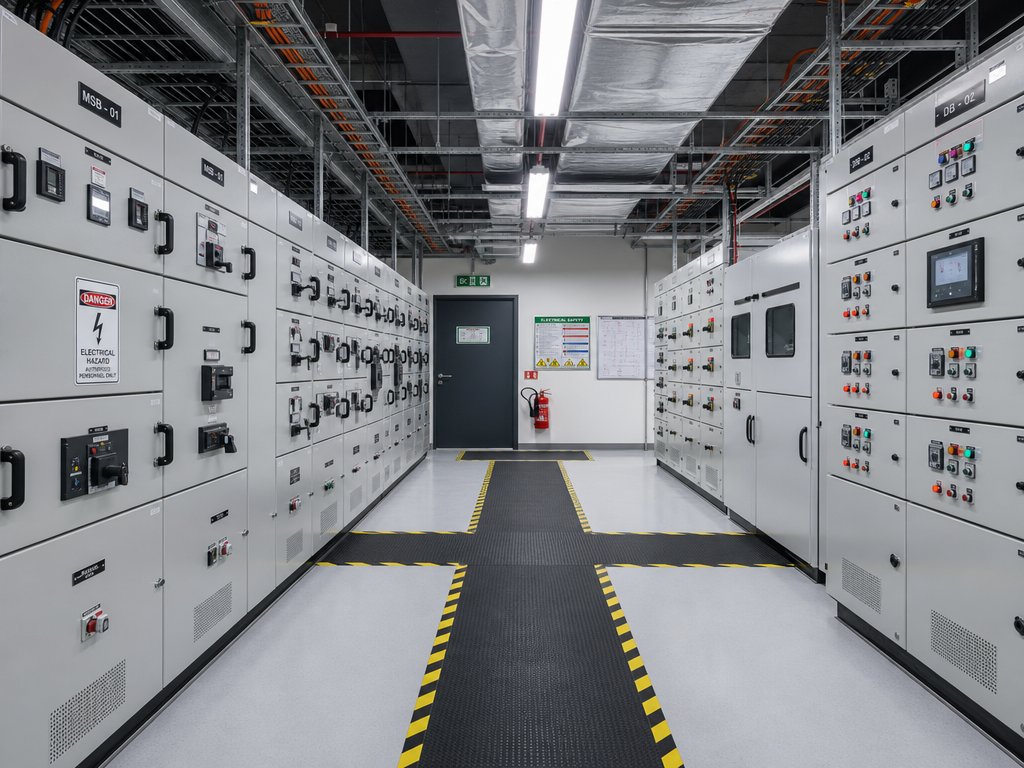
For commercial buildings, electrical inspection failure is rarely caused by one major mistake. It is usually the result of missing labels, undersized protective earth conductors, poor conduit workmanship, insufficient switchboard access, or test records that cannot prove compliance. The Engineering Institute of Thailand electrical installation framework, commonly referenced as EIT 2564 or วสท. 022001-22, gives designers, contractors, owners, and municipal inspectors a common basis for low-voltage installation safety.
This checklist is written for practical site use. It is not a substitute for the official EIT standard, project specifications, utility requirements, or the authority having jurisdiction, but it highlights the items most likely to be checked before commercial building handover.
1. Pre-Inspection Document Checklist
- Approved electrical drawings: Confirm that single-line diagrams, load schedules, feeder routes, grounding diagrams, and panel schedules match the actual installation.
- Calculation records: Keep load calculations, voltage-drop checks, short-circuit calculations, protective device coordination, and earthing conductor sizing available for review.
- Material compliance: Submit certificates for cables, conduits, switchboards, circuit breakers, residual-current devices, cable trays, lugs, glands, and grounding accessories.
- As-built revisions: Mark all route changes, spare conduits, changed breaker ratings, and final circuit numbers before municipal inspection.
- Test reports: Prepare insulation resistance, continuity, earth resistance, polarity, RCD trip test, phase sequence, and functional test records.
2. Low-Voltage Grounding and Bonding Checklist
- Main earthing terminal: Provide a clearly identified main earthing bar or terminal at the main switchboard. It must be accessible for testing and future maintenance.
- Protective earth continuity: Ensure every exposed conductive part of switchboards, panels, transformers, cable trays, metallic conduits, equipment frames, and metal enclosures is bonded to the protective earth system.
- Correct conductor identification: Protective earth conductors should be green-yellow. Do not use a protective earth conductor as a neutral or phase conductor.
- No improper neutral-earth links: Neutral-to-earth bonding must only be installed at the permitted point of the system. Downstream distribution boards must not create accidental parallel neutral and earth paths unless specifically designed and approved.
- Earthing electrode installation: Ground rods, plates, or approved electrodes must be mechanically secure, corrosion-resistant, and connected with approved clamps or exothermic welding where specified.
- Earth resistance test: Measure and record the resistance of the earthing system using an accepted test method. Many Thai utility and inspection practices require a low and stable resistance value; confirm the project-specific target with EIT tables, MEA or PEA requirements, and the local authority.
- Equipotential bonding: Bond incoming metallic services, structural steel, water piping where applicable, lightning protection interfaces, and major mechanical equipment to reduce touch voltage risk.
- RCD and ELCB protection: Install residual-current protection where required, especially for socket outlets, wet areas, rooftop equipment, outdoor circuits, kitchens, wash areas, and maintenance circuits.
3. Switchboard and Distribution Board Inspection Checklist
- Working clearance: Maintain clear working space in front of switchboards. As a practical inspection rule, provide a clear width not less than the equipment width and not less than 0.75 m, with working depth according to the EIT voltage and exposure condition table, commonly around 0.9-1.2 m for low-voltage commercial installations.
- Headroom: Provide safe headroom for operation and maintenance, commonly not less than 2.0 m in switchboard working areas unless a project-specific approved detail states otherwise.
- No storage zone: Do not allow cleaning supplies, stock, packaging, ladders, or movable furniture inside the dedicated electrical working space.
- Door swing and access: Switchboard doors and covers must open sufficiently for maintenance, breaker operation, thermographic inspection, and emergency isolation.
- Environment: Do not install standard indoor switchboards in damp, corrosive, dusty, or outdoor locations unless the enclosure rating and ventilation are suitable.
- Identification: Label main incomer, outgoing feeders, circuit numbers, voltage, phase sequence, source, destination, emergency circuits, and warning signs in a durable manner.
- Short-circuit rating: Verify that switchboards, breakers, busbars, and control gear are rated for the calculated prospective fault current at the installation point.
- Terminations: Inspect cable lugs, ferrules, glands, torque marks, heat-shrink sleeves, shrouds, phase barriers, and segregation between power and control wiring.
- Ventilation and heat: Check that the panel is not overloaded, ventilation openings are not blocked, and thermal conditions are suitable for breaker derating and long-term operation.
4. Conduit, Cable Tray, and Wiring Route Checklist
- Correct conduit type: Use rigid steel conduit, intermediate metal conduit, EMT, HDPE, uPVC, flexible conduit, or cable tray only where suitable for the mechanical, fire, moisture, and corrosion exposure of that location.
- Conduit fill: Do not overfill conduits. Apply the permitted fill ratio from the standard and manufacturer data, allowing for conductor size, insulation type, heat, and future pulling requirements.
- Bend limitation: Avoid excessive bends. A common inspection principle is not more than 360 degrees of total bend between pull points unless additional draw boxes are installed.
- Support spacing: Support conduits, trays, and trunking at intervals required by the applicable standard and manufacturer instructions. Provide support near boxes, panels, bends, and terminations.
- Mechanical protection: Protect conduits in parking areas, loading bays, risers, service corridors, and plant rooms from impact by vehicles, carts, and maintenance equipment.
- Wet and outdoor areas: Use watertight fittings, weatherproof boxes, correct enclosure ratings, drainage strategy, and UV-resistant materials where exposed to rain or sunlight.
- Fire separation: Seal penetrations through fire-rated walls and floors with approved firestop systems. Do not leave open sleeves around electrical routes.
- Power and ELV separation: Separate low-voltage power circuits from communications, data, fire alarm, CCTV, access control, and control cables unless a compliant barrier or route is provided.
- Sharp edges and bushings: Provide bushings, grommets, locknuts, and smooth entries to prevent insulation damage at all boxes, trays, and switchboards.
5. Final Testing Before Municipal Inspection
- Continuity test: Confirm protective earth continuity from each final circuit to the main earthing terminal.
- Insulation resistance: Test phase-to-phase, phase-to-neutral, and live conductors-to-earth as required before energization.
- Earth resistance: Record grounding system resistance under site conditions and keep the instrument calibration record.
- Polarity and phase sequence: Verify correct polarity at outlets and correct phase rotation for motors, pumps, HVAC equipment, and elevators.
- RCD trip test: Confirm that residual-current devices trip within the required time and current range.
- Functional test: Test emergency lighting, fire alarm interface, smoke control, transfer switches, generators, pumps, control panels, and interlocks.
- Thermal scan: For larger commercial buildings, perform thermographic inspection after load operation to detect loose terminations, imbalance, or overloaded feeders.
6. Procurement Notes for Contractors and Developers
Passing inspection starts before installation. Specify compliant cables, conduits, grounding accessories, switchboard components, glands, cable trays, and support systems early. For commercial projects in Thailand, contractors should avoid mixing uncertified low-cost components with compliant systems, because inspectors often reject installations when material certificates, labeling, or traceability cannot be verified.
A good EIT 2564 inspection strategy is simple: design with adequate access, install with clean workmanship, document every test, and use certified materials that can be traced from purchase order to final handover.