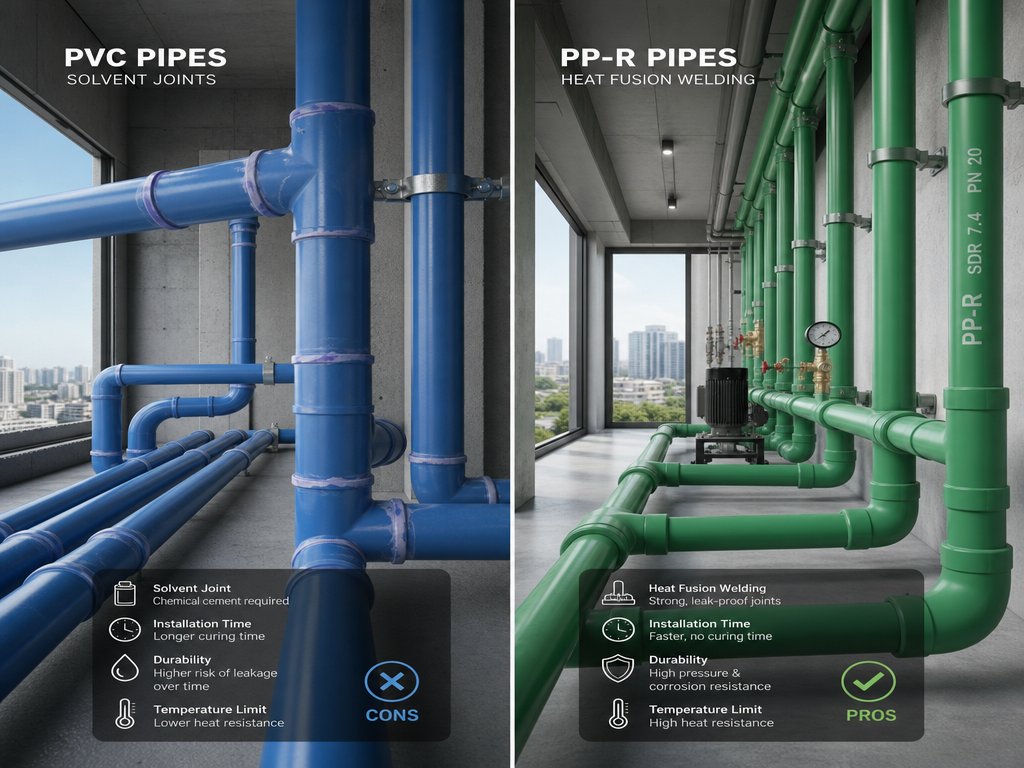
For large condominium and high-rise residential projects, the cheapest pipe per meter is rarely the lowest-cost system over the life of the building. Water supply risers, branch lines, pump rooms, and ceiling voids are difficult and expensive to access after handover. A small saving during procurement can become a major liability if leaks, shutdowns, ceiling repairs, or tenant complaints occur later.
This article compares traditional blue PVC piping with solvent-cement joints against modern green PP-R piping joined by socket fusion welding. The focus is not only material price, but total cost of ownership, including installation productivity, joint reliability, maintenance exposure, and lifecycle performance in large-scale condominium developments.
1. Material Positioning: Low Initial Cost vs. Engineered Lifecycle
Blue PVC is widely used for cold-water applications because it is familiar, economical, lightweight, and easy to cut. For low-rise buildings and accessible external distribution lines, it remains a practical option when specified and installed correctly.
Green PP-R is typically selected for higher-performance plumbing systems, including pressurized cold-water and hot-water distribution. It is valued for its fusion-welded joints, corrosion resistance, smooth internal surface, and long service-life expectations when the correct pressure class, temperature rating, and installation method are used.
- Blue PVC: lower material cost, familiar installation, solvent-cement joints, generally used for cold-water lines.
- Green PP-R: higher initial material cost, heat-fusion joints, suitable for hot and cold water depending on grade and pressure rating.
- High-rise implication: as building height, pressure zones, and access difficulty increase, joint reliability and maintenance cost become more important than pipe price alone.
2. Installation Velocity: Fast Cutting Is Not the Same as Fast Handover
At first glance, PVC appears faster. Installers cut the pipe, apply primer or solvent cement as required, assemble the joint, and wait for curing. On small jobs, this process is simple and economical. On high-rise projects, however, velocity is measured by repeatability, inspection quality, pressure-test success, and rework rate.
PP-R socket fusion requires trained workers and welding equipment, but the process is highly repeatable. Once the team is trained, each joint follows a controlled cycle: cut square, clean, heat the pipe and fitting, insert to depth, hold, cool, and inspect alignment. There is no solvent curing dependency, and the joint becomes a homogeneous fused connection rather than a glued interface.
- PVC productivity advantage: low tool cost and broad installer familiarity.
- PVC productivity risk: solvent application quality, insufficient curing time, wet surfaces, poor pipe insertion depth, or rushed pressure testing can increase rework.
- PP-R productivity advantage: consistent jointing method, clean installation, no solvent odor, and rapid progression once welding teams are organized by floor or zone.
- PP-R productivity risk: requires proper heating temperature, insertion depth control, and trained supervision to avoid misalignment or overheating.
3. Joint Reliability: The Critical Cost Driver in High-Rise Buildings
In a high-rise condominium, most failures are not caused by the straight pipe length; they occur at joints, transitions, valves, fittings, or poorly supported sections. This makes joint technology central to TCO.
Solvent-cement PVC joints depend heavily on surface preparation, solvent quality, application technique, pipe fit, ambient conditions, and curing time. When executed well, the system can perform reliably. But in large developments with thousands or tens of thousands of joints, even a small workmanship error rate can create expensive post-handover failures.
PP-R socket fusion creates a welded joint by melting and fusing the pipe and fitting together. Properly executed, the joint is designed to become an integrated plastic connection, reducing the risk of adhesive failure. For risers, shafts, and concealed ceiling areas, this joint integrity is a major operational advantage.
- Best case PVC: economical and reliable where workmanship, curing, pressure class, and application conditions are tightly controlled.
- Worst case PVC: leaks can appear from rushed curing, contamination, poor solvent coverage, or movement before the joint sets.
- Best case PP-R: fused joints provide excellent long-term integrity and are suitable for concealed and pressurized systems.
- Worst case PP-R: poor welding discipline can cause restricted bore, weak fusion, or misalignment, so training and inspection are essential.
4. 50-Year Lifecycle View: What Does the Owner Actually Pay For?
A 50-year lifecycle analysis should include more than pipe and fitting prices. For condominium developments, the owner, juristic office, facility manager, and residents bear the consequences of system performance over decades.
- Initial procurement: PVC usually has the lowest upfront material cost; PP-R normally requires a higher initial budget.
- Installation tools and training: PVC tools are minimal; PP-R needs fusion machines, calibrated equipment, and trained installers.
- Pressure testing and rework: high-quality PP-R installations may reduce leak-related rework, while PVC performance depends strongly on curing discipline and solvent-joint workmanship.
- Maintenance access: concealed leaks in shafts, walls, and ceilings are expensive regardless of pipe cost. The more difficult the access, the more valuable joint reliability becomes.
- Operational disruption: water shutdowns in occupied condominiums create complaints, compensation discussions, and reputational damage for developers and facility managers.
- Repair cost multiplication: one small leak may require ceiling removal, repainting, electrical inspection, mold remediation, and unit access coordination.
5. TCO Comparison for Massive Condominium Developments
For a small and accessible project, PVC may win on cost. For a high-rise condominium with multiple pressure zones, booster pumps, shafts, ceiling voids, and tight handover schedules, the calculation changes.
The true TCO question is: how much is the project willing to pay upfront to reduce the probability and impact of water-system failures over 30 to 50 years?
- Material-only comparison: blue PVC is typically cheaper.
- Installed-cost comparison: the gap narrows when labor supervision, curing time, testing, and rework are included.
- Risk-adjusted lifecycle comparison: green PP-R often becomes more attractive for concealed, pressurized, and high-consequence areas.
- Balanced specification strategy: some projects use PP-R for risers, shafts, pump rooms, hot-water lines, and concealed distribution, while using PVC only in lower-risk, accessible cold-water areas where allowed by specification.
6. Specification Guidance for Developers, MEP Consultants, and Contractors
The best choice is not simply PVC or PP-R. It is a system decision based on pressure, temperature, location, access, installer capability, warranty expectations, and building positioning.
- Use the correct pressure class and temperature rating for each zone.
- Specify approved fittings, valves, transition adapters, and supports as a complete system.
- Require mock-up installation and destructive or visual joint checks where appropriate.
- Control storage conditions, especially exposure to sunlight and site damage before installation.
- Document pressure testing by zone before concealment.
- Train installation crews and assign qualified supervisors for fusion welding or solvent-cement work.
Conclusion: Lowest Pipe Price Is Not the Lowest Building Cost
Blue PVC remains a cost-effective material for many cold-water applications, especially where the system is accessible and the specification is not demanding. However, for high-rise condominium water supply, the financial risk is concentrated in joints, concealed locations, pressure zones, and post-handover maintenance.
Green PP-R typically requires a higher initial investment, but its socket-fusion jointing method can deliver strong lifecycle value in large developments where reliability, reduced rework, and lower disruption risk matter. For developers and contractors evaluating TCO, the smartest decision is to compare installed system cost and long-term risk, not pipe price alone.